01
Sparse by design
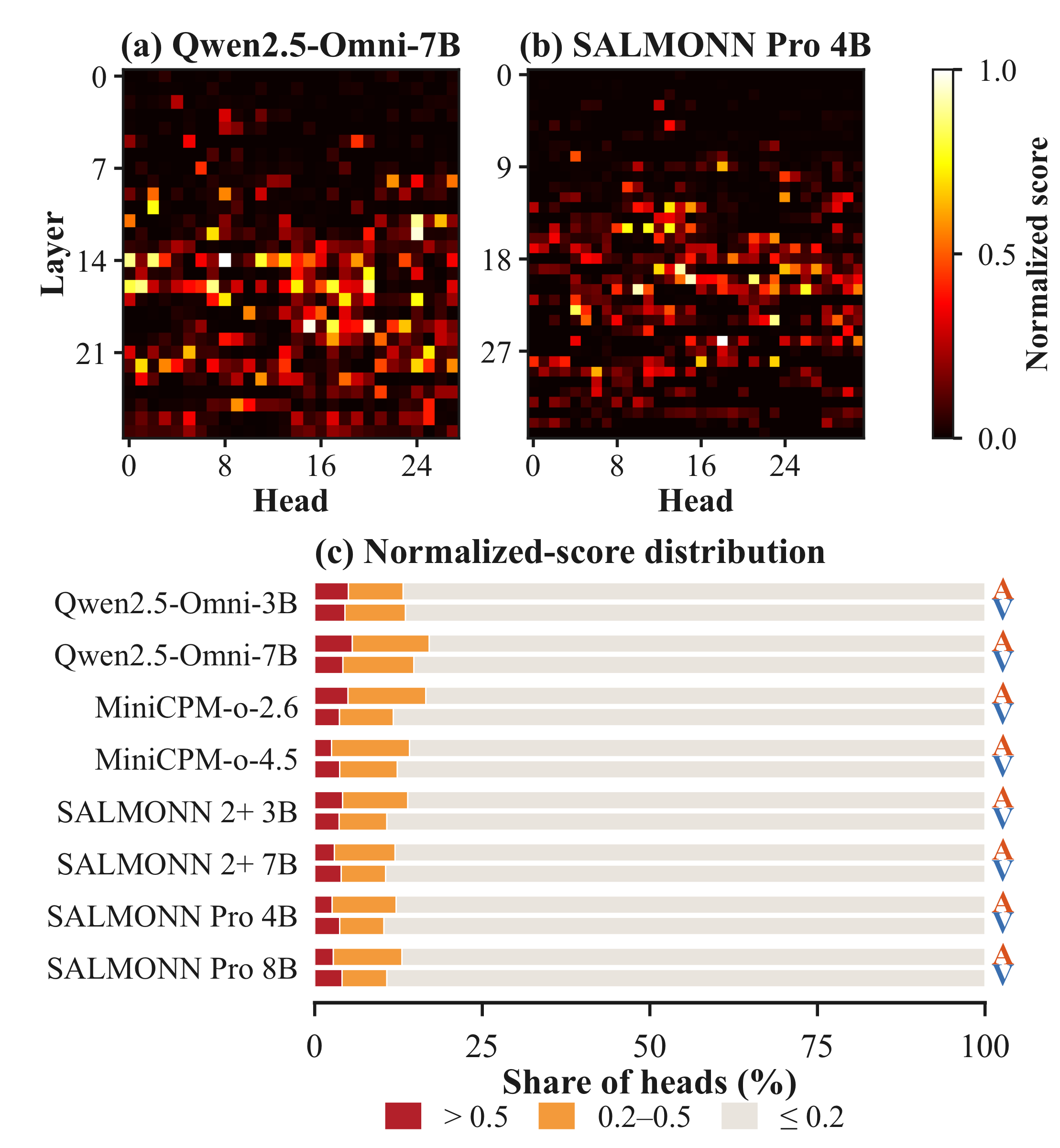
For both speech and displayed evidence, high retrieval scores concentrate in a small set of heads. In every tested omni-modal model, fewer than one in ten heads accounts for half of positive score.
arXiv:2610.32411 · Multimodal retrieval
1Institute of Information Engineering, CAS 2UCAS 3Tencent
*Equal contribution · †Corresponding author
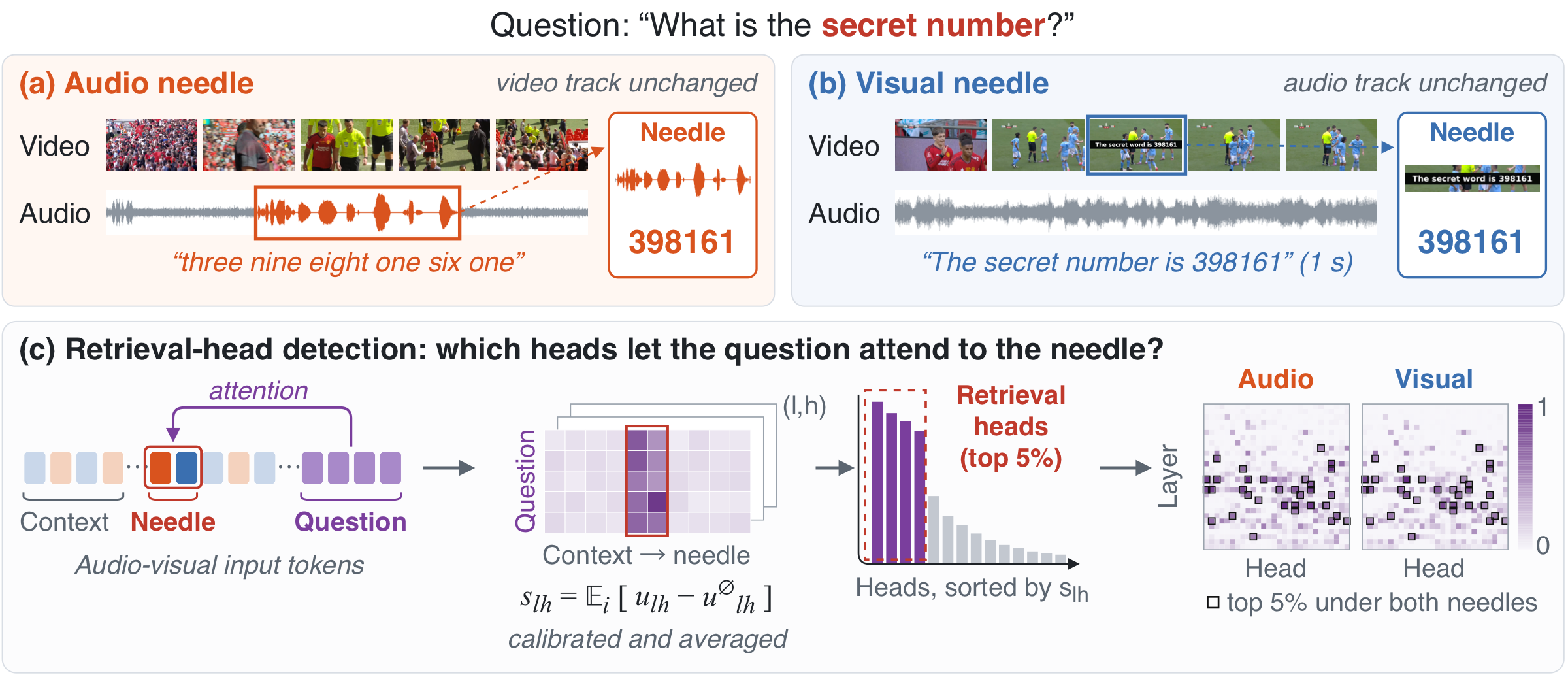
How does an MLLM locate evidence when that evidence is spoken, shown, or embedded in a long document?
We study whether the small set of attention heads that retrieves evidence in text and images also supports audio-visual understanding—and whether these functional heads can be directly optimized.
Abstract
Across 18 language, vision-language, and omni-modal checkpoints, retrieval heads remain sparse as input modalities expand. A small subset is reused for matched spoken and displayed evidence, preserved during modality adaptation, and necessary for audio-visual retrieval. We then train selected-head attention with a ranking objective, improving document retrieval across three model families.
01
For both speech and displayed evidence, high retrieval scores concentrate in a small set of heads. In every tested omni-modal model, fewer than one in ten heads accounts for half of positive score.
02
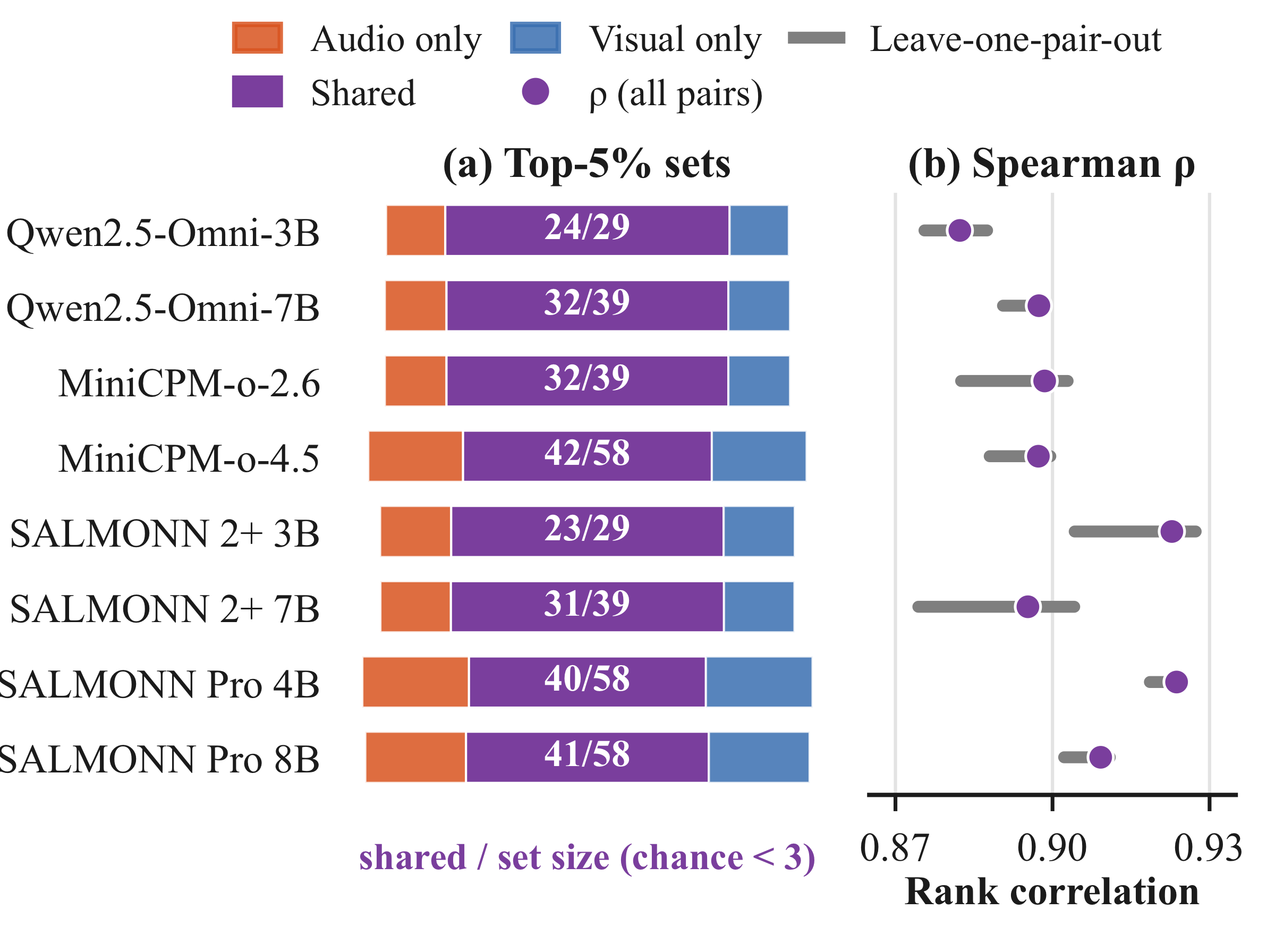
When the evidence content is matched, 69–83% of the top 5% heads are selected under both audio and visual evidence—far above independently selected sets.
03
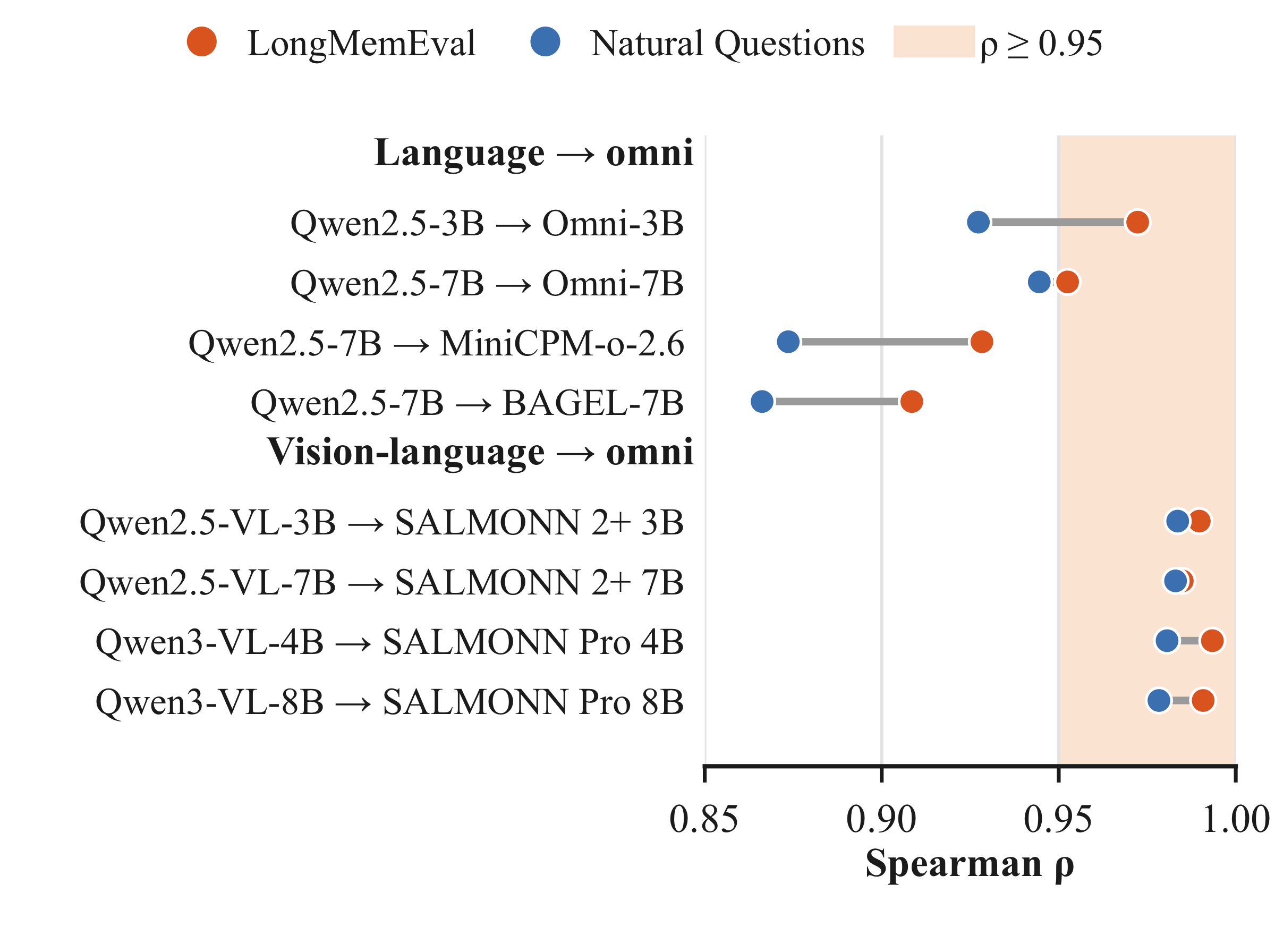
Omni-modal models preserve the retrieval-head structure of their language or vision-language backbones as they gain new modalities.
We select retrieval heads once in the base model, use their question-to-candidate attention to score pages, then train LoRA adapters with a within-document ranking objective.
Detect the highest-scoring retrieval heads under multimodal conditions and keep the set fixed.
Aggregate question-to-visual-token attention from those heads for every candidate page.
Optimize the selected attention to favor relevant pages over hard negatives from the same document.
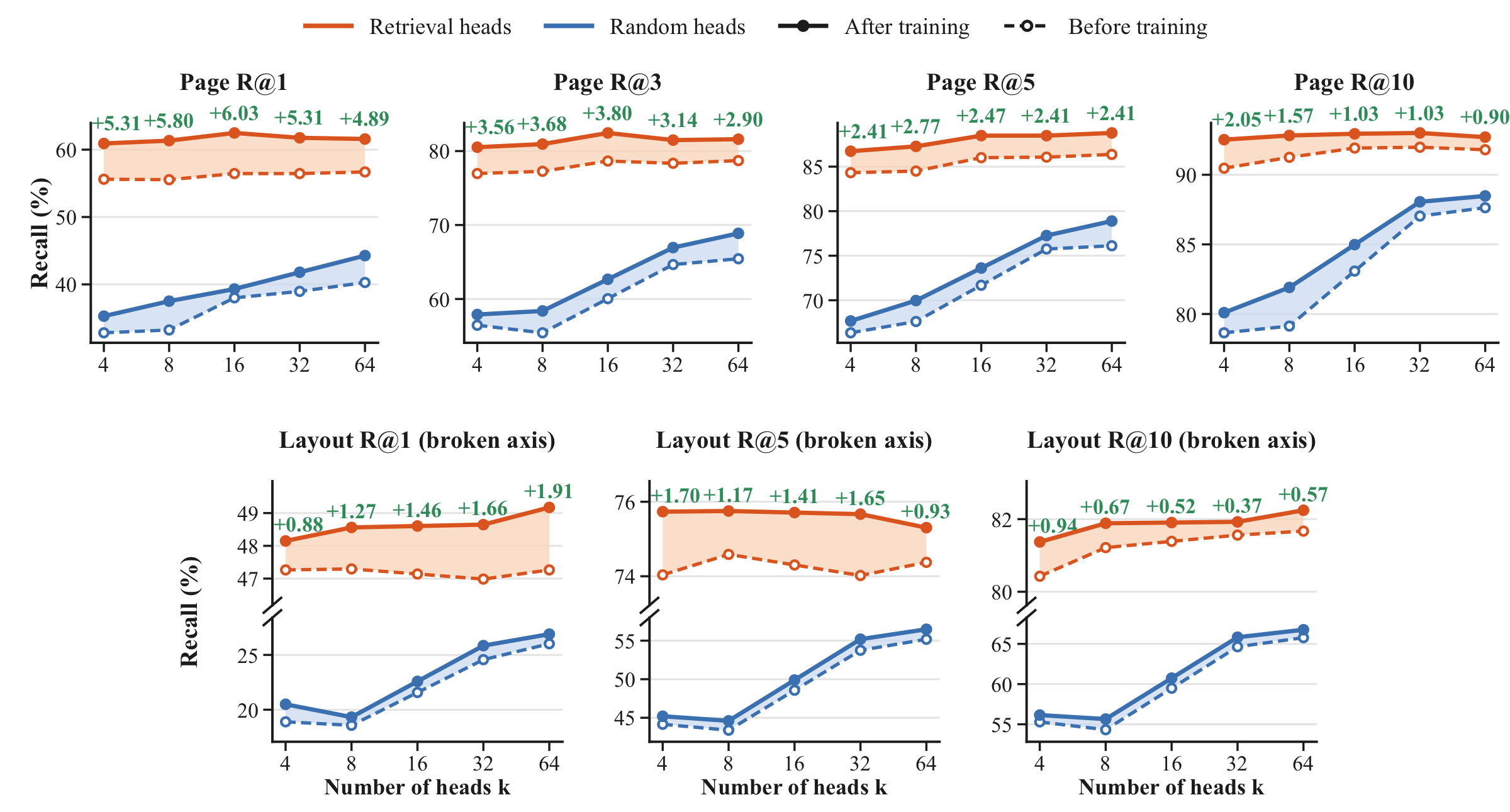
MMDocIR · Page Micro Recall@1
+6.03 points with retrieval-head ranking training
| Model | Page base | Page trained | Gain | Layout base | Layout trained |
|---|---|---|---|---|---|
| Qwen3-VL-8B | 56.45 | 62.48 | +6.03 | 47.14 | 48.60 |
| Qwen2.5-VL-7B | 52.41 | 58.10 | +5.69 | 31.79 | 32.60 |
| Gemma3-12B | 44.75 | 46.92 | +2.17 | 23.88 | 26.04 |
Transfer beyond pages. Page-level supervision also improves layout retrieval, even though the model never sees layout labels during training.
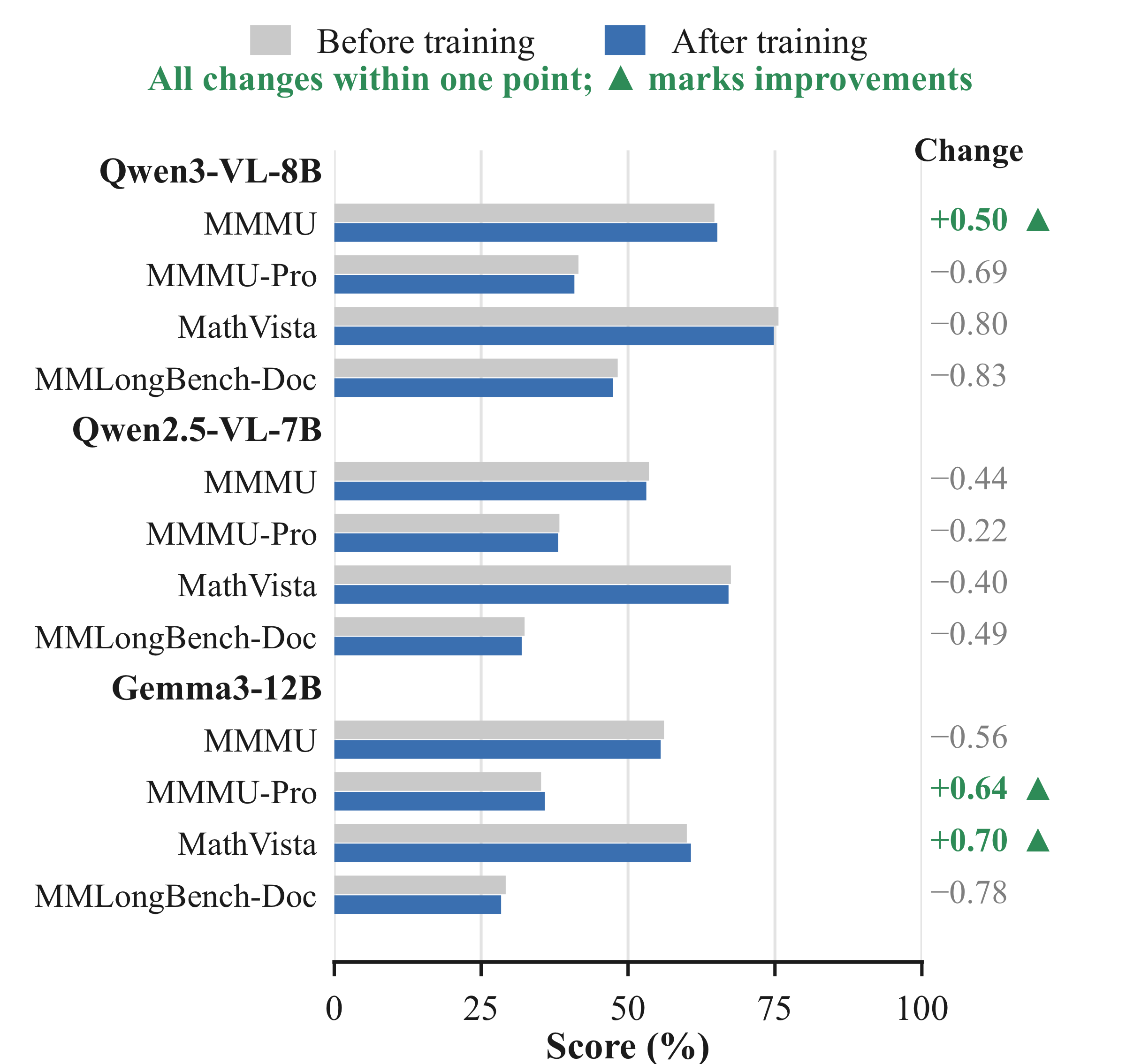
Stable out of domain. Scores on MMMU, MMMU-Pro, MathVista, and MMLongBench-Doc change by less than one point.
Please cite the arXiv preprint and link to this project page.
@article{wang2026retrievalheads,
  title   = {A Broader Look into MLLM's Retrieval Heads},
  author  = {Wang, Jia and Li, Yuqing and Li, Jiangnan and
             Lin, Zheng and Yu, Mo},
  journal = {arXiv preprint arXiv:2610.32411},
  year    = {2026},
  url     = {https://arxiv.org/abs/2610.32411}
}